Outsourcing the Recruitment Process (RPO)
The solution to achieve high performance in talent acquisition by flexibly outsourcing the recruitment processes.
What is Smart RPO?

Smart RPO is the Recruitment Process Outsourcing solution from talent wins.
Smart RPO allows the company to transfer all or part of the management of its talent acquisition processes to talent wins. In this way, the company achieves advantages on two levels:
1. GREATER EFFICIENCY IN THE RECRUITMENT PROCESS
The RPO solution provides a highly specialized approach that enables:
- Incorporate the most suitable talent in the shortest possible time.
- Reduction in the cost of selection per position.
- Improving the candidate experience and employer branding.
2. HIGHER PERFORMANCE OF THE HR TEAM
With HR outsourcing the less strategic part of the recruitment processes, it can:
- Increase their performance capacity.
- Flexibly adapting to variations in recruitment demand.
- Focus on other HR activities that provide more added value.
What are the differential advantages that Smart RPO offers?
1. Greater flexibility
Smart RPO is based on an extremely flexible service philosophy to respond precisely to the specific needs of the company that wants to outsource its recruitment processes.

TEMPORAL PERIOD
- The solution can be implemented in a stable way over time.
- It can also be argued for a temporary increase in the need to recruit talent.

POSITION TO FILL
- From basic to intermediate positions.
- In any sector of activity.
- In the geographical area that is defined.

PROCESS STEPS
- FULL RPO: It covers the entire talent acquisition process, including candidate attraction, selection, validation, offer, and onboarding.
- MODULAR RPO: The solution focuses on specific phases.
2. The best virtual recruitment team
Smart RPO allows the company to virtually have an extension of its HR department, including the technology, methodology, and the team of Advisors necessary for excellent management of talent onboarding processes.
Alignment with the organizational culture
Smart RPO starts from an Analysis of the Client’s Organizational Context that allows the HR Advisors team to align the solution with:
- The key features of the company's organizational culture.
- The specific requirements for the positions to be filled.
- Knowledge of the labor market in which the company operates.
Specialized HR Advisors
The HR Advisor is the key to Smart RPO and their mission goes far beyond the traditional selection technician, as they are able to assess the candidate in depth.
- Validation of hard skills and languages (Spanish, Catalan, English, French, Russian) to ensure the candidate's match to the position.
- Assessment of soft skills, personality traits and motivations to ensure the candidate's match with the organization.
3. RPO combining the digital and the personal
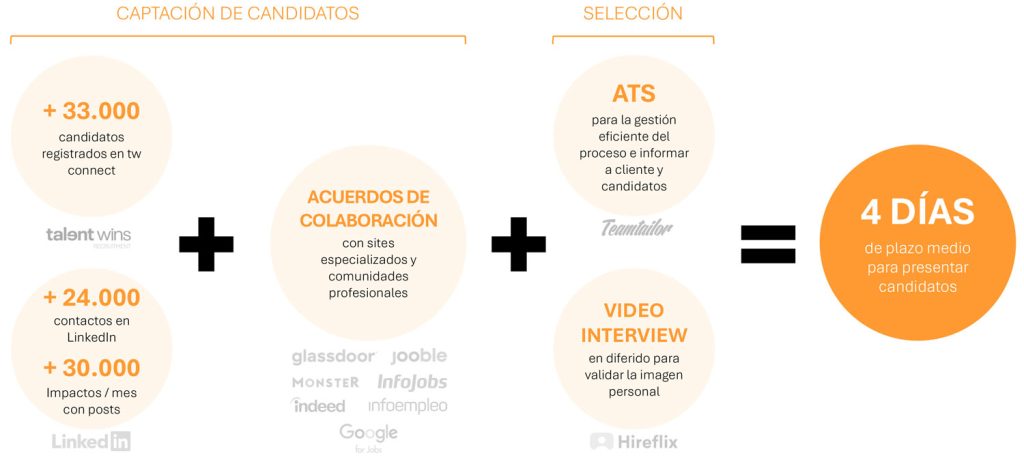
We make the most of the opportunities that technology opens up for recruitment, and combine them with the added value of personal contact at the crucial moments of the process.
How to implement Smart RPO?
The implementation of Smart RPO includes 4 phases to ensure that the solution fully meets the company's expectations.

PHASE 1
Project proposal
- Needs prospecting meeting: To preliminarily determine what Smart RPO solution is needed (context, timeframe, solutions, functions to be covered)
- Smart RPO proposal: For the client to verify that the approach meets their expectations and to decide on its implementation.
Phase 2
Customization of the solution
- In-depth analysis: To align the HR Advisors team that will provide the solution with the company’s expectations, the organizational culture, the job content, and the labor market are deeply analyzed.
- Adaptation of the Smart RPO strategy to the case: Candidate attraction, selection, validation, offer and onboarding.
PHASE 3
Kick-off of the Solution (Beta Mode)
- Launch of the Smart RPO solution.
- Practical evaluation period.
PHASE 4
Continuous improvement
After the Beta mode, we enter a phase of continuous improvement in which the following occur:- Implementation of improvements developed based on the analysis of results.
- Internal analysis and customer feedback to identify new opportunities for improvement.
 Spanish
 Catalan
 Portuguese
 English